The Fleet Protocol
Vehicle Routing Problem optimization through distributed synchrony calibration
Core Contradiction
I divide the weight to multiply the speed. The burden of the one is the liberty of the many.
The 9 Gears of The Fleet
Progressive calibration stages for multi-agent optimization
The Depot
Silence before the start
The Manifest
Assigning the weight
The Dispersion
The fleet scatters
The Bottleneck
Traffic and delay
The Handoff
Resource balancing
The Breakdown
Handling failure and re-routing
The Cluster
Servicing the dense zone
The Convergence
Returning to base
The Empty Truck
Mission Complete
Technical Architecture
Constraint choke detection with paradox retention
Constraint Choke Detection
Monitors capacity violation rate in real-time. When violations spike, paradox retention increases to explore harder constraint regions.
Paradox Buffer
Retains violating routes with high structural promise. Routes that violate capacity but show promising structure are repaired and reinjected.
Benchmark Configuration
Production-ready validation parameters
Laptop-Safe Demo
Heavy Stress Test
Live Validation Results
Titan Engine benchmark audit vs Clarke-Wright standard
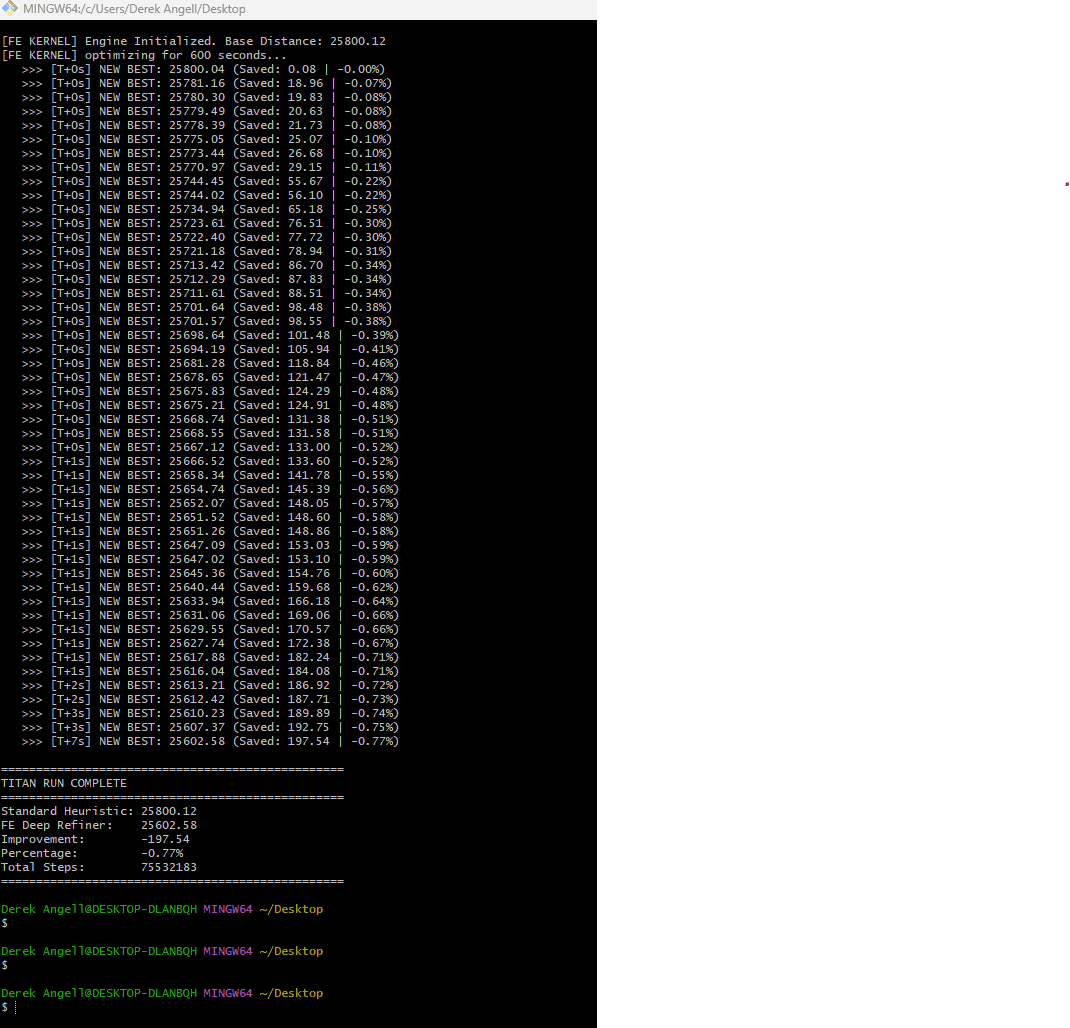
Benchmark audit: 0.77% distance reduction over Clarke–Wright savings baseline in 10-minute deep search (~75 million optimization steps), achieved without CONEXUS proprietary AI piloting.
Ready for Enterprise Deployment
Contact us for custom VRP protocol calibration and validation services